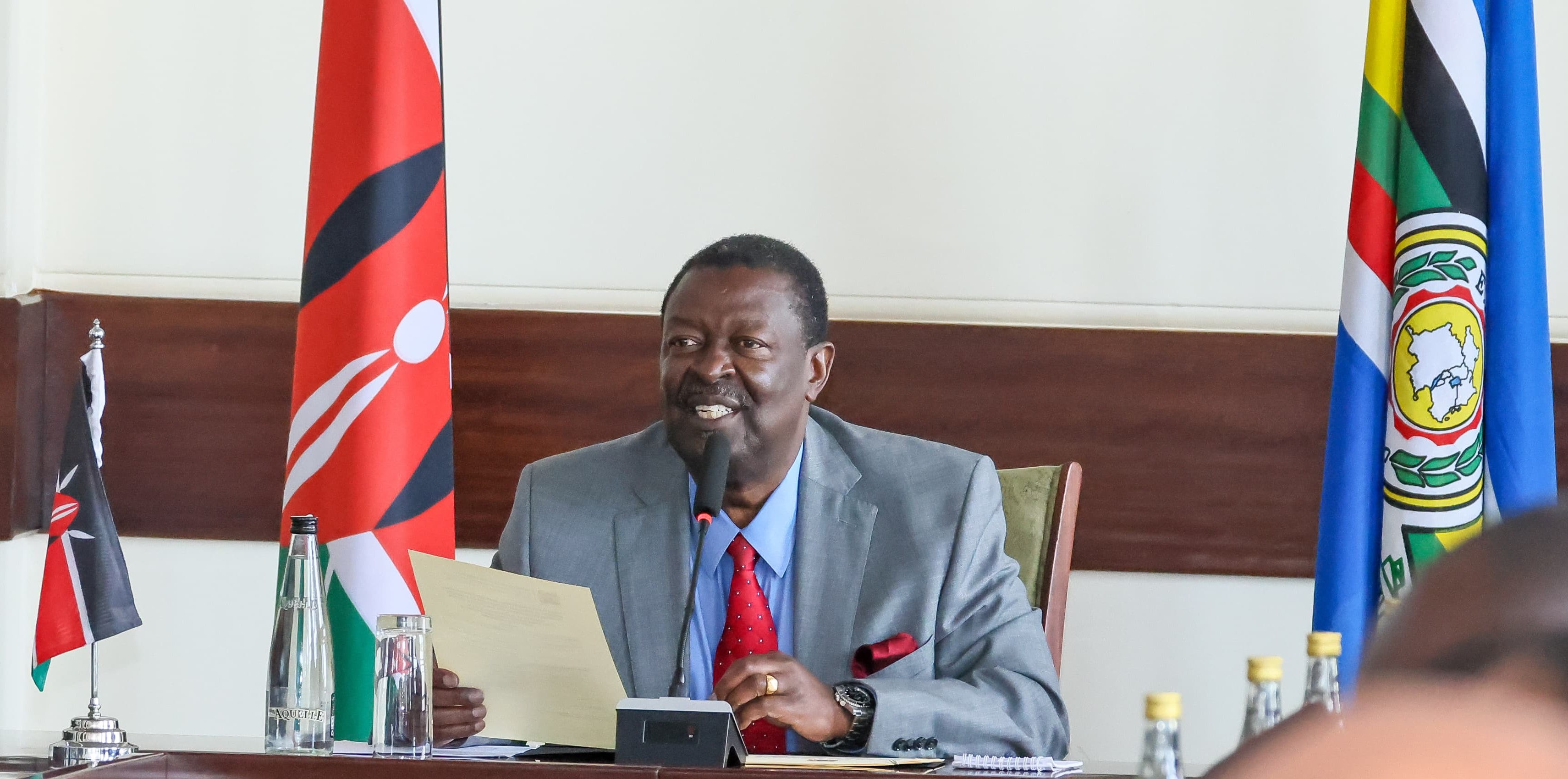
Mudavadi Pushes for Public-Private Collaboration to Boost Business
Prime Cabinet Secretary Dr. Musalia Mudavadi has said the government and the private sector will have harmonised document on the ease of doing business which will be launched by April.
Mudavadi called for enhanced public-private collaboration to improve the country's business environment noting that the private sector was a key driver to a robust economy and job creation.
Speaking when he convened a stakeholder engagement meeting with the private sector, Mudavadi said that in the next three months, the government and the private sector will agree on a matrix indicating action points and by who and when.
“We have tasked a secretariat made up of the government and the private sector to work on a matrix indicating who is to do what, when, and the deliverables. This should be in place by April so that all the proposals will be included in the Budget Policy Statement and other relevant legislations on the ease of doing business in Kenya,” said Mudavadi.
In the meeting themed, "The Ease and Cost of Doing Business and Facilitation of a Smooth Business Environment for the Private Sector", the Prime Minister said that there was a need to unite in pursuit of a shared goal of creating an environment where business can flourish and investment in Kenya can thrive
The meeting brought together Cabinet Secretaries, Principal Secretaries, and key stakeholders from both the private sectors, including the Kenya Private Sector Alliance (KEPSA), Kenya Association of Manufacturers, Kenya National Chamber of Commerce (KNCCI), Kenya Flower Council, and Kenya Leather Development Council.
Emphasizing the government’s role in facilitating business, Mudavadi quoted economist Milton Friedman: ‘The business of government is to facilitate business.’
He stressed the importance of public servants becoming catalysts for economic growth, driven by the private sector.
Mudavadi called on the private sector as the backbone of the economy, citing examples from across Kenya, including farmers in Kilifi and entrepreneurs in Thika. He reiterated the government’s commitment to clearing the path for these business people, rather than obstructing them.
Addressing the challenges in the current business environment, PCS acknowledged excessive bureaucracy, outdated regulations, and inefficient infrastructure as significant barriers. He invited the private sector to provide candid feedback.
‘This meeting is an opportunity for those of you in the private sector to tell us ‘Where the shoe pinches, ‘he added.
Mudavadi outlined three critical areas for improvement: regulatory and bureaucratic frameworks, infrastructure investment, and the fight against corruption. He highlighted the need for transparency to become the norm.
PCS stressed the importance of a robust public-private dialogue, stating that meaningful progress requires government and private sector collaboration.
He invoked an African proverb: ‘If you want to go fast, go alone. If you want to go far, go together,’ urging unity for sustained economic growth.
He emphasized that the government's role is to create an enabling environment for businesses to thrive. In return, the private sector should drive job creation, innovation, and economic prosperity.
Mudavadi also focused on empowering Kenya’s youth, describing them as the present drivers of innovation and creativity. He called for policies that foster an ecosystem where young entrepreneurs can flourish, warning that sidelining the youth would impoverish society.
The PCS quoted Theodore Roosevelt: “Do what you can, with what you have, where you are.’ He advocated for a ‘whole of systems approach’ to harmonize efforts across sectors, institutions, and disciplines, aiming to enhance efficiency and maximize impact.
‘Together we have the tools, the talent, and the persistence to achieve greatness,’ Mudavadi noted, setting a collaborative tone for the future of Kenya's economic environment Secretary for National Treasury John Mbadi took to respond to the challenges and recommendations raised by the private sector. He highlighted the importance of exempting commodities rather than zero-rating them to simplify tax processes.
CS Mbadi emphasized the need to streamline tax refunds, addressing concerns that unpaid tax refunds curtail working capital. He assured that the government is committed to resolving this issue to improve cash flow for businesses.
The private sector also raised concerns about pending bill payments, non-tariff barriers on priority products, the Tax Law Amendment Bill 2024, and the stabilization of the inflation rate. These issues were identified as critical areas that need immediate attention to enhance the ease of doing business.
Responding to these recommendations, Mbadi reiterated the government's commitment to addressing these challenges. He noted that clearing pending bills and stabilizing the inflation rate are priorities for fostering a conducive business environment.